
How Peeples Middle School Logged 2 Million Points and 5,500 Rewards in One Year
Four years into PBIS with paper bucks and spreadsheets producing no usable data, Peeples Middle School in Jackson, Mississippi switched to LiveSchool and recorded 2 million points in a single school year. A physical school store moved 5,500 rewards, a local hospital contributed $1,500 annually, and the school maintained a 4:1 positive-to-negative feedback ratio.
“I've been in education 14 years, and I've never seen a program working as well as this one is. Y'all have really met the need of schools doing PBIS, especially in urban schools. To have this tool, which is so user friendly, is a game changer.”
On this page
Paper Bucks, Spreadsheets, and No Data
For the first four years of its PBIS implementation, Peeples Middle School ran behavior tracking on paper. Teachers handed out printed bucks and behavior tickets. Administrators tried to follow up with spreadsheets. The system was a mess – burdensome to staff, invisible to parents, and incapable of producing the data administrators needed to understand what was actually happening in classrooms.
The inconsistency was the biggest problem. With no shared platform, every teacher ran their own version of the token economy, and there was no way to measure fidelity or compare outcomes across the building. The school knew PBIS was the right framework, but paper bucks were not the right tool to sustain it.
Over the summer, administrators began researching digital alternatives. They found LiveSchool and recognized immediately that it solved the pain points they had been living with: inconsistency, lack of data, and the sheer burden of managing a paper-based system. The team brought it to staff before the next school year, and the rollout that followed would produce numbers no one at Peeples had imagined possible.
Students Who Held Teachers Accountable
The rollout started with an honest conversation. Staff sat together and reviewed discipline challenges from the previous year, examined their behavior data, and discussed the role of schoolwide expectations, better data, and stronger relationships with students. LiveSchool became the tool that tied those elements together – a single place for teachers to award behavior points, track comments and negative behavior, and share progress data with students and parents.
Most teachers bought in immediately. As the school began handing out weekly paychecks – printed summaries of each student's points – something unexpected happened. Students started holding teachers accountable. They would ask for more opportunities to earn points, and when a teacher forgot to award them, students were proactive about speaking up. It was a kind of positive peer pressure that got the entire community involved.
For the teachers who were slower to adopt, the enthusiasm of the students became the turning point. When a classroom full of kids is asking to earn points, the path of least resistance is to participate. Teachers who use LiveSchool's random student selector for cold-calling found another incentive: the student called on earns a point right away for participation, and the momentum stays positive even during the most challenging academic content. By the end of the first year, usage data told the story – the building had logged 2 million points.
A Store Inspired by Chuck E. Cheese
From the beginning, the team at Peeples wanted a physical space – a place where students had to walk in and make real decisions with the points they had earned. The inspiration came from an unlikely source: Chuck E. Cheese and other stores that kids love to visit. The school store needed to feel like an event, not a transaction.
The space had to be lockable, since inventory grew quickly. Setting prices was an exercise in behavioral economics. Too low and students would buy everything up in a week. Too high and nobody would bother saving. The sweet spot kept the store shelves moving and students motivated.
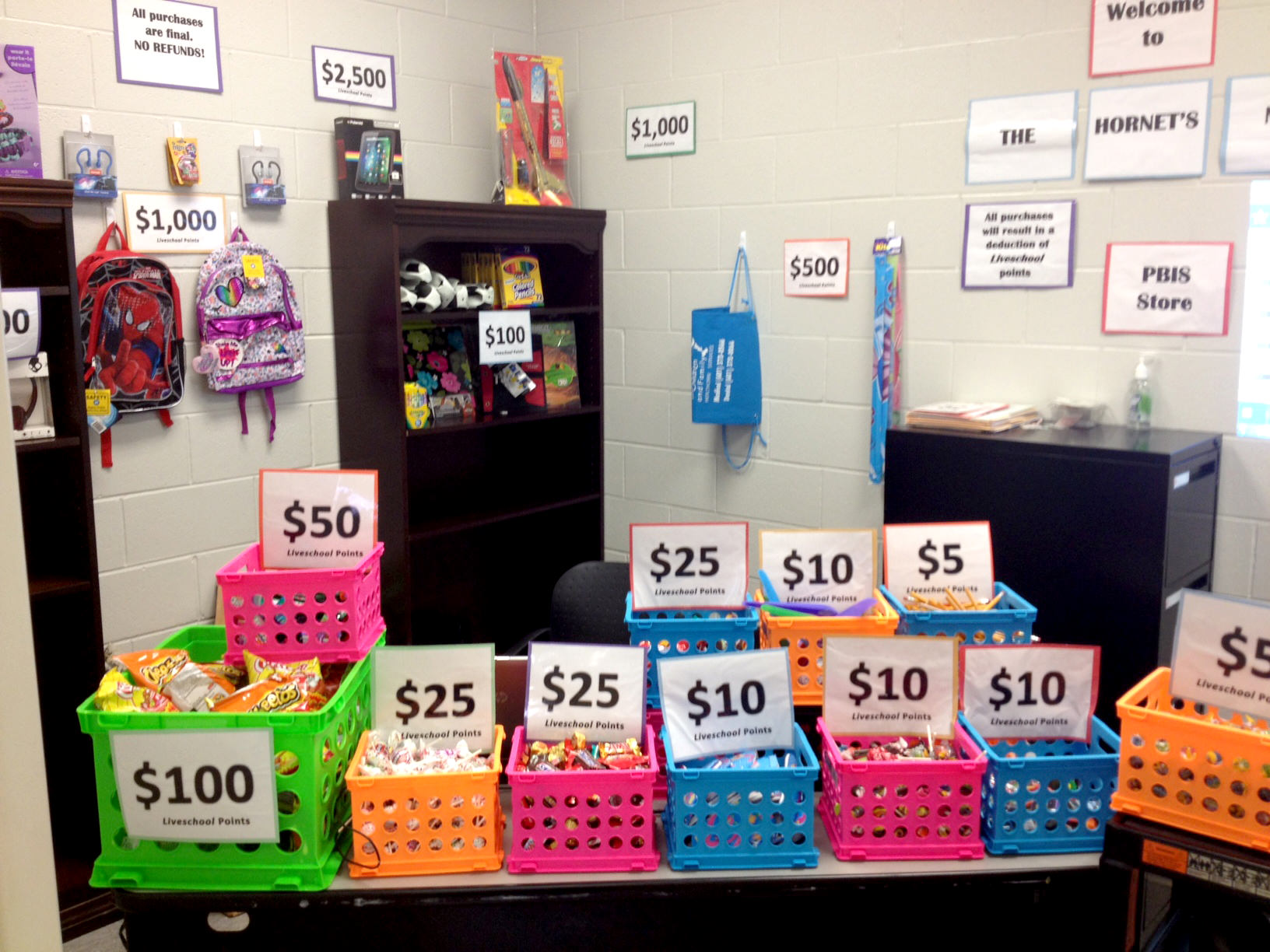
Students could spend their points on everything from snacks and school supplies to experiences like wearing jeans for the day, attending dances, and buying tickets to basketball games where students played against the teachers. By the end of the year, the store had processed 5,500 rewards – a volume that proved the economy was not just running, but thriving.
At the end of each school year, students could convert their excess points into raffle tickets. The more points a student had banked, the more tickets they could buy. The raffle itself featured big-ticket items that kept students engaged and motivated straight through the final weeks of school, when momentum at most buildings starts to fade.
Trivia, Fundraising, and Fifty-Point Bonuses
The point economy at Peeples extended well beyond the classroom. Every morning, an academic trivia question was read over the loudspeaker. Students submitted their answers to a box in the cafeteria at lunch. The next day, a name was drawn from the correct entries and announced to the entire school – the winner earned a 50-point bonus. The daily ritual gave students an academic challenge to look forward to and kept the cafeteria buzzing with conversation about the answer.
Funding the rewards economy required creativity. A local hospital had adopted Peeples through a community partnership and contributed $1,500 per year specifically for student incentives. That money stretched further than most schools would expect, because the team learned early that experiences often mattered more to students than physical items. Dances, jeans days, and teacher-versus-student games cost very little but generated enormous excitement.
Some students spent every point they earned on snacks, and the staff considered that perfectly fine – but they consistently encouraged saving. The store became an informal financial literacy curriculum. Students who saved their points for bigger-ticket items experienced the satisfaction of delayed gratification, while the spenders learned through trial and error that the raffle tickets and exclusive events went to the students who had budgeted their balances throughout the year.
Parents Nagging Their Way to Back-to-School Night
Parent engagement had been a persistent challenge at Peeples, and back-to-school night attendance was a sore spot. The team tried a simple experiment: they offered a LiveSchool points bonus for every student whose parent attended. The result was immediate. Students went home and nagged their parents to show up. The kids understood the points economy well enough to know that attendance equaled earning potential, and they applied pressure where it mattered most – at the dinner table.
The strategy worked because it turned students into advocates for their own school community. Parents who came to back-to-school night saw the LiveSchool system in action, understood how their children were being recognized, and left with a clearer picture of the school's expectations. The points bonus was a small investment that paid off in a much larger parental connection to the building.
Students played the same advocacy role inside classrooms. When teachers who had not fully adopted the system would forget to give out points, students spoke up. They were the biggest cheerleaders for full staff participation, and their enthusiasm made it harder for any teacher to sit on the sidelines. As one student put it: “What I like about LiveSchool is that you can behave and get all the points that you desire. When I first found out about it I was in shock – I couldn't wait to receive my first paycheck.”
Two Million Points and a 4:1 Promise
By the end of the first full year with LiveSchool, Peeples had recorded 2 million points across the building. The 4:1 ratio of positive to negative feedback held steady – a number that demonstrated the staff was recognizing students four times for every correction, building the kind of trust-based culture that PBIS research consistently identifies as the threshold for meaningful change.
The students themselves noticed the difference. One student described the feedback loop simply: “I think that what I like most about it is that it tells me what I am doing wrong and that I should fix it and it shows me what I do good and tells me to keep up the good work.” Another captured the breadth of the reward economy: “I like LiveSchool because if we have enough points we can pay for a ticket to wear jeans, have dances, and buy a ticket to go to basketball games and see the students play against the teachers.”
For the staff, the numbers validated what the hallways already showed. A school that had spent four years tracking behavior on paper with nothing to show for it had built a functioning economy, a physical store that processed thousands of transactions, and a community-wide culture of recognition – all in a single year. Fourteen years of teaching had not produced anything like it, the team said. LiveSchool had met the need of a school doing PBIS in an urban setting, and the tool's simplicity was what made the difference.
More stories you might like
How Taylor Middle School Went from Zero Positive Data to 98% Attendance
Once labeled one of the worst middle schools in the community, Taylor Middle School in Lovington, New Mexico rebuilt its culture through five years of PBIS implementation. The school now awards over 163,000 points per year, has 94% of staff actively recognizing students, and holds approximately 98% daily attendance.
How Heritage Middle School Turned Behavior Data into Videos, Scavenger Hunts, and a Nacho Bar
At Heritage Middle School in Liberty, Missouri, a 10-person PBIS committee meets monthly to dig into discipline data – then spends no more than seven minutes looking at it before shifting to action. They pick one behavior at a time, involve students in creating the solutions, and reward the results with zero-cost experiences like three-on-three tournaments and scavenger hunts designed by eighth graders. Principal Reagan Allegri trusts the committee to run the program and the students to own the culture.
How Bate Middle School Cut Referrals by 81% by Leading with Positivity
When JD Smith became assistant principal at Bate Middle School, he and new principal Michelle Carver made a bet on culture. Two years later, referrals dropped from 687 to 131, out-of-school suspensions fell from 152 to 18, and an anonymous state survey showed a 46-percentage-point increase in teachers' confidence managing student behavior.