
How the Dulles School of Excellence Built a Safe Haven with 35,000 Positive Interactions
On Chicago's South Side, where 90% of students live in a neighboring housing project, Culture and Climate Coordinator Larry Williams built a three-tier PBIS and SEL program that achieved 100% staff adoption and logged over 35,000 positive interactions – supported by a Tiger Store, House competitions, and weekly parent Recaps.
“If we don't set high expectations for our students, they have nothing to reach for.”
On this page
A Safe Haven on the South Side
At the Dulles School of Excellence, school is much more than a place to learn. It is a safe haven. Located on the South Side of Chicago, 90% of Dulles’s students live in the housing project next door to the school – a neighborhood with a high level of violence. Making sure students can detach from the outside world is Larry Williams’s job.
Williams is the school’s Culture and Climate Coordinator. Everything non-academic, he covers. His mission is to build a supportive community that nurtures the academic and emotional well-being of every student who walks through the door. As any educator knows, education is not simply about knowledge acquisition – it is about developing life skills to become productive and caring citizens. Without the ability to regulate their emotions and act appropriately, students cannot learn.
Williams brought Positive Behavioral Interventions and Supports and social-emotional learning to Dulles because those frameworks had already transformed his own classroom into an engaging and organized learning environment. Scaling them to an entire K–8 building, however, required a tool that could manage the program across every hallway, classroom, and grade level.
From Paper Bucks to a Platform That Worked
Williams’s first instinct was to build a paper-based token economy – printed bucks that teachers would hand out and students would collect. But printing paper currency and manually tracking how it was distributed meant a lot of work with very little visibility into what was actually happening.
The school then brought on ClassDojo, but that experiment surfaced several problems. The platform combined a social network with student behavior tracking, which put student data and privacy at risk. It allowed users to change or delete messages after sending them, creating opportunities for misuse. It did not provide schoolwide rubrics or data, so there was no path to consistency or fidelity. And Chicago Public Schools banned the use of ClassDojo outright, with other districts following suit.
Williams set out to find something better. He needed a platform that could deliver schoolwide rubrics, protect student privacy, generate real-time data across all three PBIS tiers, and give parents a window into their children’s daily progress. He found LiveSchool, and the school has not looked back.
ROARS, PRIDE, and Three Tiers of Support
The Dulles School of Excellence uses the ROARS and PRIDE acronyms to anchor its Tier 1 PBIS strategies. Every student learns what those letters stand for, and every teacher uses the corresponding LiveSchool rubric to recognize students who demonstrate those behaviors throughout the school day. Social-emotional learning competencies are built directly into the same rubric, so staff can recognize SEL skills in action and track student growth over time.
For students who need more targeted support, Dulles manages Check-In and Check-Out directly through LiveSchool. Students assigned to CI/CO are paired with a specific mentor for daily meetings where they can earn up to five points. At the end of each week, a separate meeting evaluates the sum of the week’s behavior, and students can earn an additional 50 points. The weekly structure is deliberate – a bad day does not mean a student receives no points for the entire week. According to Williams, this approach builds trust among students in every tier, and the school is already noticing improvements in behavior.
Dulles also tracks in-school suspensions and detentions as deductions, but this section of the rubric is admin-only. Only approved administrators can add deductions, which prevents misuse and keeps the system’s positive framing intact for the teachers and students who interact with it daily.
Seventy-Eight Points and a Tiger Store
Throughout each day, students can earn a total of 78 points across their classes and common areas. The students are serious about receiving them. Walk the halls at Dulles and you will hear kids say: we are being really quiet – are you going to give us hall points? Teachers are held accountable for awarding points consistently; it is a part of their coaching and performance reviews.
The points flow into a reward economy that touches every part of the school. The Tiger Store is a PBIS and attendance store where students pay to enter with their LiveSchool points and choose from school swag, trinkets, games, and toys. Points also count toward milestone events like the eighth-grade trip, the pinning ceremony, and the class luncheon – Dulles covers the cost for these events, but students who lose points lose access unless their parents pay out of pocket. That policy keeps parents invested in their children’s daily behavior alongside the school. Pizza parties and other celebrations round out the experience-based side of the economy.
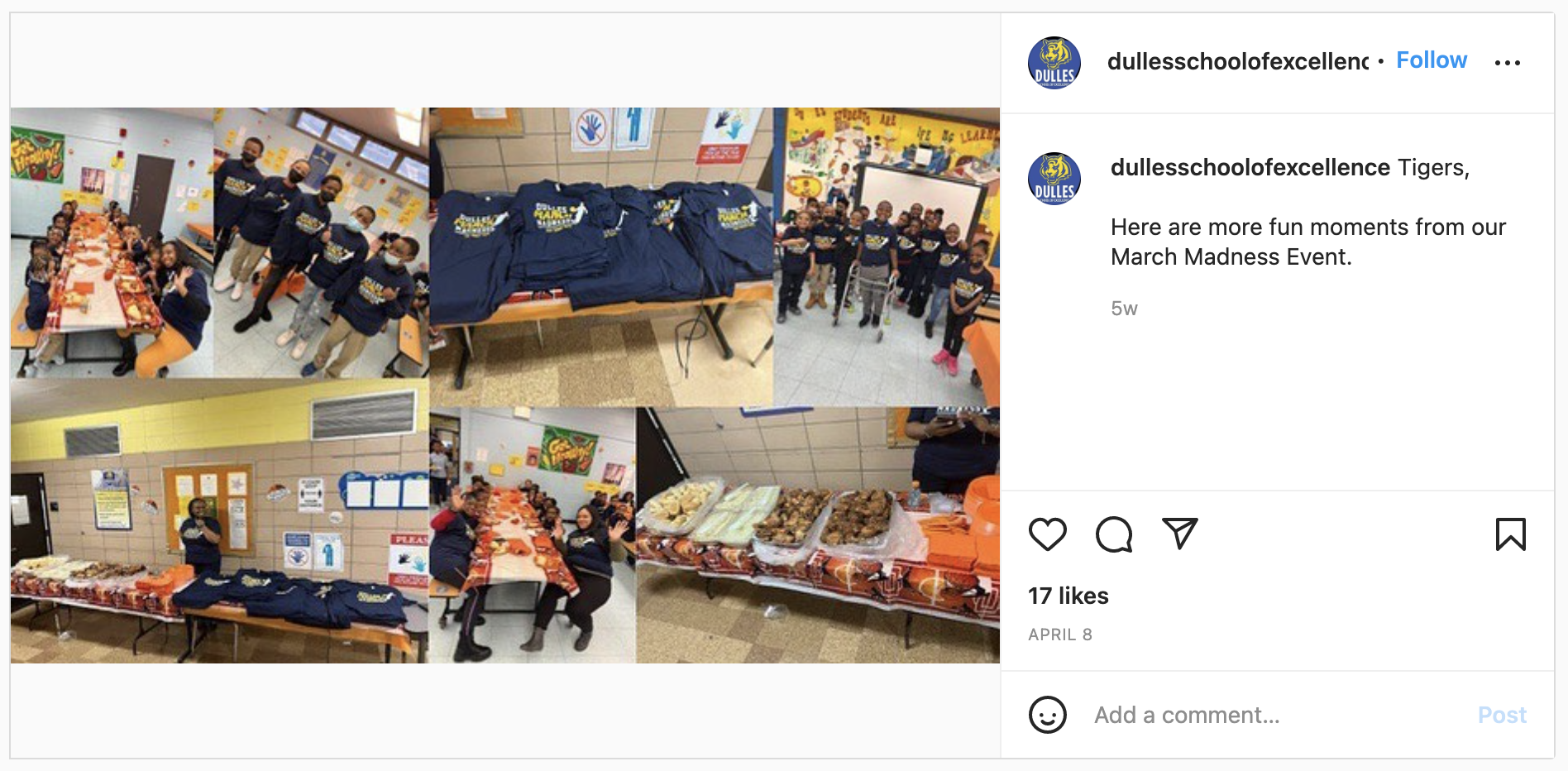
The points also feed into a schoolwide House competition. Students are divided into Houses by grade, and every point earned or lost adds to the group total, which is displayed on a dashboard visible to the entire school. Events like the March Madness competition celebrate the top Houses – the winning class earned custom t-shirts – and the leaderboard creates a layer of friendly rivalry that keeps students motivated well beyond their individual balances.
Weekly Recaps and the Parent Connection
LiveSchool’s built-in Recaps feature became a cornerstone of Dulles’s family engagement strategy. Every week, automated emails go out to parents and students recapping the points awarded and lost over the previous seven days, including any comments that teachers attached to individual interactions. For a school where 90% of students come from the housing project next door, that weekly touchpoint is not a luxury – it is a lifeline.
Recaps enable Dulles parents to see the smaller wins and areas for improvement that happen on a daily basis. A parent who cannot attend a conference still knows whether their child earned hall points on Tuesday or lost access to an event on Thursday. The transparency builds trust between the school and families who may not have had positive experiences with schools in the past, and it gives Williams and his team a communication channel that requires no additional effort once the points are entered.
The combination of parent visibility, student accountability, and teacher consistency created something Williams had been working toward since his classroom days: a community where everyone – teachers, parents, students, and administrators – is participating in the same system toward the same goals.
Data That Coaches Teachers and Sets Goals
The power of Dulles’s PBIS and SEL programs lives in the data. With LiveSchool, Williams and his team can track everything happening across the school in real time. Reports surface the most common positive and negative behaviors, identify the top and lowest student earners, reveal which teachers are giving the most and fewest points, and display the ratio of positive to negative interactions across every classroom.
The Dean of Students pulls reports weekly and shares them with the entire staff. Those reports create opportunities for meaningful discussion, collaboration, brainstorming, and goal-setting that would have been impossible under a paper-based system. In one-on-one coaching sessions, administrators can sit down with a teacher, pull up their individual data, and have a conversation rooted in specifics rather than impressions.
The data also creates integrity and transparency for the program as a whole. It ensures teachers are giving points fairly, catches problem classes and students before issues escalate, and allows the school to set schoolwide goals and track progress against them. With 100% of staff using the platform and more than 35,000 positive interactions logged, the numbers tell the story of a building that chose high expectations over low ones – and built the infrastructure to back them up every single day.
More stories you might like
How PS/IS 119 Made Every Adult a Point-Giver and Raised Student Belonging 14%
When Principal Asia Robinson Atkins arrived at PSIS 119 in Queens during the pandemic, she found a K–8 school of nearly 1,300 students where third graders didn’t know seventh graders existed. She built a four-house system, recruited four teacher-coordinators, and gave every adult in the building – from kitchen staff to school safety agents – the power to award points. In year two, student belonging rose 14% and the school recorded 218,000 positive behavior points.
How Herbert Carter Built Student Voice with Live Broadcasts and Personality Houses
Assistant Principal Johan Gray and his team turned a K–8 magnet school into a media-savvy, personality-driven community. With daily YouTube Live announcements, a corny joke segment that costs just LiveSchool points, and a house system sorted by character traits instead of random assignment, Herbert Carter has seen discipline workloads drop dramatically while student engagement soared.
How Bonlee School Built a Schoolwide Reward System From Scratch in Year One
In their first year with LiveSchool, Bonlee School created a unified positive behavior currency across K-8, rolled out creative rewards like a gaming truck and principal Uber rides, and began planning a house competition to tackle their toughest challenge: cafeteria behavior.