
How McKinley Tech's Teacher Think Tank Made PBIS Work for High Schoolers
When McKinley Tech introduced PBIS to their high school, they didn't hand teachers a manual. They handed them ownership. A 5-person teacher think tank defined the school's values, designed the point economy, and proved that even high schoolers get excited about earning recognition.
“You think high school kids aren't going to care, they're too cool – no, they really do get into it. If you build it, they will come.”
On this page
Watch the Story
The Challenge: PBIS in a High School
McKinley Tech is a 9–12 campus in Washington, DC where many teachers had spent years building their own classroom management systems. When the administration introduced LiveSchool as a schoolwide PBIS platform, the reaction was familiar: another initiative that would fade by winter break.
The dean of students, Ryan Sturdivant – himself a McKinley graduate from the class of 2013 – knew the skepticism was warranted. High school teachers are used to managing behavior independently. And high schoolers? Everyone assumed they were too cool to care about earning points.
The typical top-down rollout wasn’t going to work. McKinley needed a different approach.
The Think Tank
Within the first month of the school year, two teachers stood out: Desiree Caldwell, a 16-year English teacher, and Tony Gross, a biology teacher who had seen LiveSchool implemented at two previous schools. They were giving out more points than anyone else in the building.
Instead of leadership mandating participation, Desiree and Tony asked a simple question: How can we get more teachers to love this as much as we do?
They sent out a survey and assembled a five-teacher committee – a think tank – to define what LiveSchool would look like specifically at McKinley. Not a one-size-fits-all rollout. Their own.
The committee established three guiding norms:
- Rewarding students for what they do right is equally if not more important than penalizing them when they do wrong.
- Building a culture of celebration prevents problem behavior in the first place.
- It has to be a whole-school approach – a small group of teachers using the system won’t move the needle.
The CARE Framework
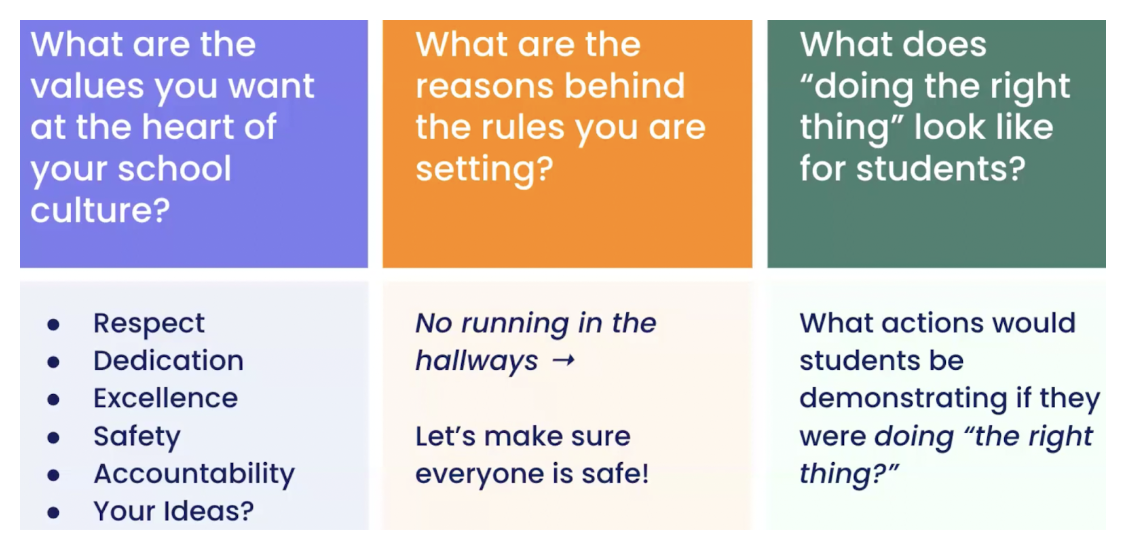
The committee’s biggest task was translating McKinley’s identity into a behavior rubric. They landed on four core values – Care, Achievement, Respect, and Excellence – each with specific, observable behaviors teachers could recognize.
The framework gave every teacher the same language without prescribing how to use it. A biology teacher emphasizing critical thinking could award Excellence points for higher-level questioning. An English teacher focused on collaboration could award Care points for peer support during group work.
As Tony put it: the framework becomes a reflection of what each teacher values in their classroom, but all the pieces interact and play nicely together.
Building the Economy
Getting the point economy right took iteration. The deans set initial values, the committee redesigned them, and they adjusted again based on teacher feedback. The final system: up to 10 points per student per class period, four classes per day, for a maximum of 40 points daily.
The tiered reward system gave students real choices. Early in the year, wearing a Halloween costume cost 25 points. Attending the fall festival cost 75. A silent party and ice cream social were offered on the same day so students could pick.
Something unexpected happened: students became strategic budgeters. They’d skip smaller rewards to save for bigger events, calculating whether they had enough points for what was coming next. Ryan noted the system was accidentally teaching financial literacy – students learning to budget without realizing it.
The rewards weren’t limited to schoolwide events. Individual teachers could create classroom-level rewards – homework passes, pizza parties, student-of-the-month recognition – all running through the same point system.
What Surprised Them
The biggest surprise was how much the high schoolers cared. Desiree described pulling up LiveSchool on her smartboard and using the randomizer to pick students for questions – awarding points live in front of the class. She’d walk around during small group work with the app on her phone, giving points in real time.
Tony, who had seen LiveSchool at a middle school and a KIPP campus in San Antonio, shared a strategy from his previous school: flexible point economics. If attendance was slipping, double the points for being on time that week. If uniforms were an issue, temporarily increase the reward for meeting dress code. Small tweaks to the economy could target specific behavioral trends without overhauling the whole system.
The family connection mattered too. Weekly recap emails went home showing each student’s positive interactions, giving parents a window into their child’s day that went beyond grades and discipline notices.
The Playbook
McKinley’s approach distilled into four principles any school can replicate:
- Acknowledge and reward teacher effort. Put it on your weekly checklist. Teachers who feel recognized for using the system will keep using it.
- Provide ongoing training and support. One PD session at the start of the year isn’t enough. Film tips teachers can watch asynchronously. Schedule regular check-ins.
- Foster collaboration. Great implementation doesn’t happen in silos. The think tank model lets teachers own the system rather than merely comply with it.
- Communicate clearly and constantly. After winter break, McKinley noticed a dip in point-giving. Direct communication brought it back. As Ryan put it: some may think you’re being a pest, but it’s about building school culture, and that starts with communication.
The process wasn’t clean. The point values changed multiple times. The committee debated whether to have many specific options or a few broad values. None of that mattered in the end – what mattered was that teachers had a voice in the system they were being asked to use.
As Tony reflected at the end of the year: “I was one of those teachers that had my own thing going on. When LiveSchool came around, it was great to see it standardized across classrooms – using similar language, contributing to the same mission.”
More stories you might like
How Wirt County High Let Students Write the Rules – Referrals Dropped 48%
When Callie Doherty needed a behavior system that 290 high schoolers would actually respect, she did something unusual: she let them build it. Student council wrote the rubric, planned the rewards, and ran the store – while referrals dropped 48% and attendance climbed from 85% to 89%.
How Taylor Middle School Went from Zero Positive Data to 98% Attendance
Once labeled one of the worst middle schools in the community, Taylor Middle School in Lovington, New Mexico rebuilt its culture through five years of PBIS implementation. The school now awards over 163,000 points per year, has 94% of staff actively recognizing students, and holds approximately 98% daily attendance.
How Beasley Elementary Cut Hallway Referrals from 32 to 2 – One Goal at a Time
Beasley Elementary in Lamar CISD cut hallway discipline referrals from 32 to just 2 and eliminated specials class incidents entirely – by starting with one focused goal and getting every teacher rowing in the same direction. A $5,000 rewards budget, a marketing-inspired delivery schedule, and giant teddy bears did the rest.